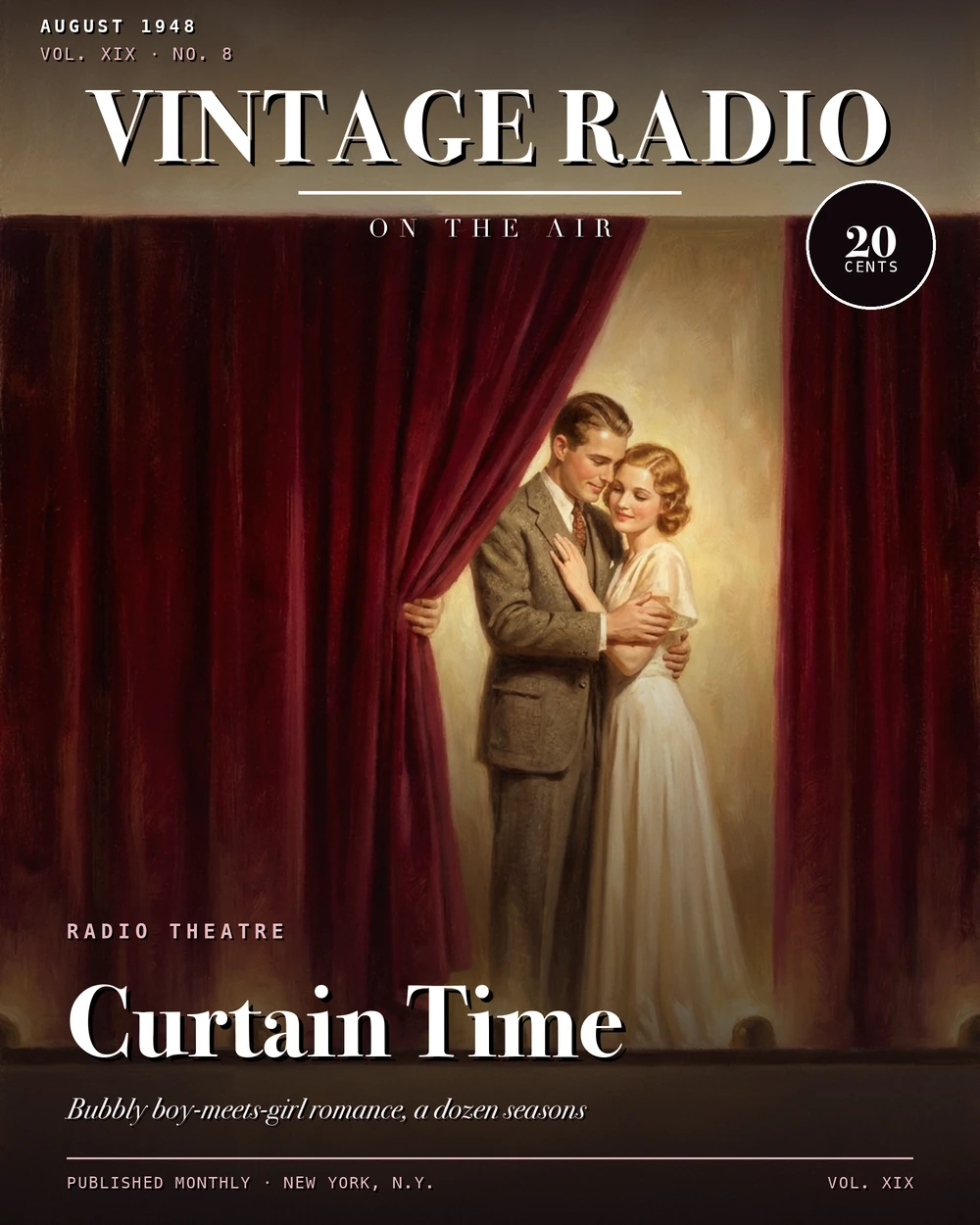
Curtain Time
The Theater Conceit
"Tickets, please, thank you, sir." An announcer playing the role of usher would guide imaginary theatergoers to "seventh row center, seats seven and eight," and then came word that the curtain was about to go up. The conceit was lifted directly from The First Nighter Program, the NBC anthology that had turned the theater-as-radio-framing-device into a genuine draw, and Curtain Time's creators made no secret of what they were after — the same large audience First Nighter had built. What they delivered was a rotating set of bubbly boy-girl romance stories, a small ensemble of versatile Chicago actors playing different roles each week, and a run that stretched across three networks and twelve years.
How It Got on the Air
The show started quietly. It launched as a local program on WMAQ in Chicago in 1935, moved to WGN in October 1937, and by October 1938 was also airing on the Don Lee regional network. A trade note in Broadcasting that year flagged that the show might be extended nationally "in late summer" — and it was. The national Mutual run began July 22, 1938, with General Mills signing on for its Korn Kix cereal in a 52-week deal. That first network run aired Fridays at 10 and lasted through March 31, 1939.
After a gap of several years, Curtain Time returned on ABC starting July 4, 1945, sponsored by Mars Candy. It moved from Wednesdays at 9 to Thursdays at 10 in October 1945 and ran through June 1946. Mars stayed on when the show shifted to NBC in July 1946, where it aired Saturdays at 7:30 before moving to a Wednesday 10:30 slot in October 1948. The NBC run continued until March 29, 1950.
The Cast
The early Mutual run centered on Olan Soule in the featured male lead, rotating through anthology roles alongside Chicago actresses including Betty Lou Gerson and Louise Fitch. Soule had come up through seven years of Chicago stage work before entering radio in 1933 — he was already an established name locally by the time Curtain Time went national. He would later spend nine years as the male lead on The First Nighter Program, the very show Curtain Time was modeled after, which made him a neat piece of connective tissue between the two series. His career eventually encompassed nearly 7,000 radio shows and commercials, more than 200 television series, over 60 films, and the voice of Batman in animated series from 1968 to 1983.
The later runs (1945–1948) featured Harry Elders and Nannette Sargent as the primary rotating leads, with Beverly Younger sharing female lead duties with Sargent. Supporting players included Betty Winkler, George Cisar, Beryl Vaughn, Sunda Love, Sidney Ellstrom, Maurice Copeland, and Michael Romano — a small Chicago ensemble whose vocal range let them inhabit fresh characters every week without most listeners noticing the overlap. Patrick Allen served as host around 1948. Blair Walliser directed the early run; Harry Holcomb directed the later years. Music came from Henry Weber in the Mutual period and Bert Farber afterward.
The Announcer Who Became Famous for Something Else
The later run's announcer was Myron "Mike" Wallace, who escorted fictional audience members to their seats and delivered the Mars Candy commercials. Wallace had returned to Chicago after wartime service as a Navy communications officer and was working freelance, announcing several programs — Sky King, The Green Hornet, The Spike Jones Show — alongside his work on Curtain Time. The contrast with his later career is significant: Wallace was one of the original correspondents on CBS's 60 Minutes when it debuted in 1968 and remained with the program until 2006, building a reputation as one of television's most formidable interviewers. The bubbly theater-usher persona and the tough-journalist persona belong to the same man, separated by about two decades.
What Survives
Around 84 recordings of Curtain Time are known to exist, representing roughly 40 hours of programming. Among the confirmed survivors is "Romantic Development," broadcast February 14, 1948, in which Harry Elders and Nannette Sargent played a young architect and the woman opposing his land development plans in a small Connecticut town. An earlier one, "Mr. Justice Jimmy," dates to April 5, 1947. The Mars Candy commercials came through intact on these recordings, mid-episode breaks and all — a small bonus for anyone interested in how sponsored radio actually sounded in practice.